
 W3C
W3CThe Resource Description Framework (RDF) is the foundational data model of the Semantic Web, providing a standard method for describing and exchanging graph-structured data on the World Wide Web. Originally conceived for metadata description, RDF has evolved into a general-purpose framework for representing information about any kind of resource in a machine-readable way.
Background
RDF emerged from several converging efforts in the mid-1990s. Its design drew from the W3C's Platform for Internet Content Selection (PICS), a web content labeling system, as well as the Dublin Core metadata initiative and Ramanathan V. Guha's Meta Content Framework (MCF) developed at Apple and Netscape. The first public draft appeared in October 1997, produced by a W3C working group with representatives from IBM, Microsoft, Netscape, Nokia, Reuters, and others.
The W3C published the first RDF Recommendation in 1999 as the "Model and Syntax Specification." This was replaced in 2004 by a suite of six specifications covering the primer, concepts, XML syntax, semantics, vocabulary description (RDFS), and test cases. The current version, RDF 1.1, was published as a W3C Recommendation on February 25, 2014, consisting of another six documents updating each component.
Purpose & Scope
RDF provides a minimal, abstract data model based on triples: statements of the form subject-predicate-object. Subjects and predicates are identified by IRIs (Internationalized Resource Identifiers); objects may be IRIs, blank nodes, or literal values. This simple structure can represent arbitrarily complex relationships and is well suited to merging data from heterogeneous sources without prior schema agreement.
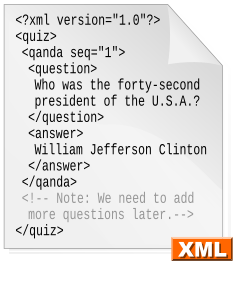
The framework is format-independent — RDF defines an abstract graph model that can be serialized in multiple syntaxes. It is not tied to XML, despite the historical association with the RDF/XML serialization.
Serialization Formats
| Format | Description |
|---|---|
| Turtle | Compact, human-friendly syntax; most widely used |
| N-Triples | Simple line-based format, easy to parse |
| N-Quads | Extension of N-Triples for named graphs |
| TriG | Extension of Turtle for datasets with named graphs |
| JSON-LD | JSON-based serialization for web developers |
| RDF/XML | Original XML serialization; still in use but less preferred |
| Notation3 | Non-standard superset of Turtle with inference rules |
Core Vocabulary
The RDF specification defines a small set of built-in classes and properties. The rdf: namespace provides rdf:type, rdf:Property, rdf:Statement, collection constructs (rdf:List, rdf:first, rdf:rest), and reification vocabulary. The rdfs: namespace (defined by RDF Schema) adds rdfs:Class, rdfs:subClassOf, rdfs:domain, rdfs:range, rdfs:label, and rdfs:comment, forming the basic building blocks for ontology construction.
Query and Validation
SPARQL is the standard W3C query language for RDF graphs, reaching Recommendation status in 2008 with a major update (SPARQL 1.1) in 2013. For validation and constraint checking, SHACL (Shapes Constraint Language) is the predominant W3C standard, complemented by the community-developed ShEx (Shape Expressions).
Governance & Maintenance
RDF is maintained by the World Wide Web Consortium. Development occurs through dedicated W3C Working Groups that produce Recommendation-track documents. The RDF 1.1 suite was produced by the RDF Working Group; subsequent work including RDF 1.2 drafts continues under W3C community processes.
Notable Implementations
RDF underpins major knowledge systems including Wikidata, DBpedia, and the Linked Open Data cloud. It is used by Creative Commons for license metadata, by MusicBrainz for music data, and by the Cochrane Library for clinical evidence annotation. Triplestores such as Apache Jena, Virtuoso, GraphDB, and Amazon Neptune provide native RDF storage and SPARQL query capabilities. The technology is fundamental to the library and cultural heritage sectors through standards like BIBFRAME, SKOS, and Dublin Core's RDF encodings.
Related Standards
- RDFS — provides the basic schema vocabulary for RDF
- OWL — extends RDFS with more expressive ontology constructs
- SKOS — RDF vocabulary for knowledge organization systems
- JSON-LD — JSON-based RDF serialization
- FOAF — RDF vocabulary for describing people and relationships
- DCAT — RDF vocabulary for dataset catalogs
- VoID — RDF vocabulary for describing linked datasets
- Schema.org — broad vocabulary partly expressible in RDF