

 VAMP
VAMPThe Astronomy Visualization Metadata (AVM) standard provides a structured framework for tagging astronomical outreach imagery with descriptive, positional, and technical metadata. Managed by the Virtual Astronomy Multimedia Project (VAMP) and endorsed by the International Virtual Observatory Alliance (IVOA), AVM enables systematic indexing and retrieval of public-facing astronomical images from observatories worldwide.
Background
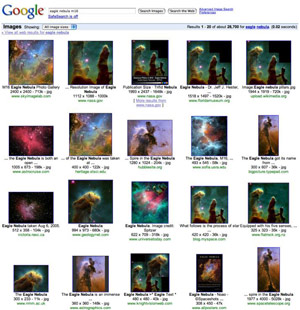
The AVM standard emerged from a practical problem facing the astronomical outreach community: the lack of any standardized method for describing and discovering astronomical imagery across observatory archives. Each major facility maintained its own image gallery with its own organizational scheme, making cross-archive searching effectively impossible. Search engines returned duplicated, low-resolution copies of popular images while burying unique content from smaller observatories.
The concept for AVM and the broader VAMP initiative originated around 2007 through collaboration between visualization and communications experts at several major astronomical institutions. The project was driven by professionals at the Spitzer Science Center, ESA/Hubble, the California Academy of Sciences, IPAC/IRSA at Caltech, and the University of Arizona. Version 1.0 of the AVM standard was endorsed by the IVOA, with subsequent refinements leading to the current version 1.2.
Purpose & Scope
AVM is specifically tailored to public-friendly astronomical imagery — the polished, processed images produced for press releases, educational materials, and public engagement. Its scope encompasses:
- Observation imagery: multi-wavelength composites from research telescopes
- Artist's concepts and diagrams: illustrative material depicting astronomical phenomena
- Simulations: visualization output from computational astrophysics
- Photography: ground-based astrophotography and observatory facility images
The standard serves multiple audiences: museum professionals seeking exhibit material, publishers looking for print-quality astronomical images, educators compiling teaching resources, planetarium software developers needing dynamically loaded sky imagery, and innovative web application builders requiring standardized access to astronomical visual content.
Key Elements
AVM metadata fields are organized into several functional categories:
| Category | Description |
|---|---|
| Creator Metadata | Contact information, rights, and credit for the image creator |
| Content Metadata | Subject category, object names, descriptions, and distance information |
| Observation Metadata | Telescope, instrument, spectral band, and observation date |
| Coordinate Metadata | Full World Coordinate System (WCS) tags for sky position, orientation, scale, and projection |
| Publisher Metadata | Publishing organization and identifier information |
The coordinate metadata is particularly significant, as it allows images to be precisely located on the celestial sphere. This enables applications like desktop planetariums and virtual observatory tools to overlay outreach imagery onto sky maps at the correct position and scale.
Serializations & Technical Formats
AVM is designed to be embedded directly within image file headers using Adobe's Extensible Metadata Platform (XMP). This approach means the metadata travels with the image file itself, surviving copying, uploading, and redistribution. Where possible, AVM fields are mapped directly to established International Press Telecommunications Council (IPTC) fields, making them immediately readable by standard media management software packages such as Adobe Photoshop, Lightroom, and Bridge.
AVM also draws on IVOA metadata conventions for astronomical datasets, extending them with fields specific to the outreach context. The standard follows XMP's XML-based serialization within image headers, using custom AVM namespaces alongside standard IPTC/XMP namespaces.
Governance & Maintenance
The AVM standard is maintained by the Virtual Astronomy Multimedia Project, a collaborative effort between individuals at several major astronomical institutions. The IVOA endorsement provides the standard with institutional backing from the international astronomical community. Development and coordination occur through the VAMP mailing list and through direct collaboration among partner institutions.
Key participating organizations include the Spitzer Science Center, ESA/Hubble (now ESA/Webb), the Chandra X-Ray Observatory, the California Academy of Sciences, and IPAC/IRSA at Caltech. The standard has been stable since version 1.2, reflecting its mature and well-defined scope.
Notable Implementations
Several major astronomical observatories and projects actively use AVM tagging:
- ESA/Hubble and ESA/Webb: systematic AVM tagging of all press release imagery
- Chandra X-Ray Observatory: tagged image archive
- Spitzer Space Telescope: early adopter and implementation partner
- AstroPix: an image search portal that relies on AVM metadata for cross-archive discovery
- Microsoft WorldWide Telescope: uses AVM-tagged images for sky overlay features
- Stellarium: integration with AVM-tagged image sources
Related Standards
AVM builds on and interoperates with several related standards. The IPTC Photo Metadata standard provides the photographic metadata foundation. The IVOA's various data access protocols (Simple Image Access Protocol, Table Access Protocol) provide the infrastructure for querying image archives. XMP provides the embedding mechanism. The World Coordinate System conventions from the FITS standard provide the astronomical coordinate framework that AVM adapts for outreach imagery.